

What To Know
- As NASA plans to build a base on the surface of the Moon, engineers from the agency recently released a rather worrying report.
- The purpose of this program is the creation of a lunar gateway, a sort of small orbital habitat to facilitate missions to and from the surface of the Moon.
- The quantities of goods to be delivered will increase sharply to reach between two and a half and ten tons per year according to estimates, with sometimes special deliveries of around fifteen tonnes.
As NASA plans to build a base on the surface of the Moon, engineers from the agency recently released a rather worrying report. Indeed, there appears to be a very significant gap between current cargo delivery capabilities and future needs.
Mixed fleet of landers headed for the Moon
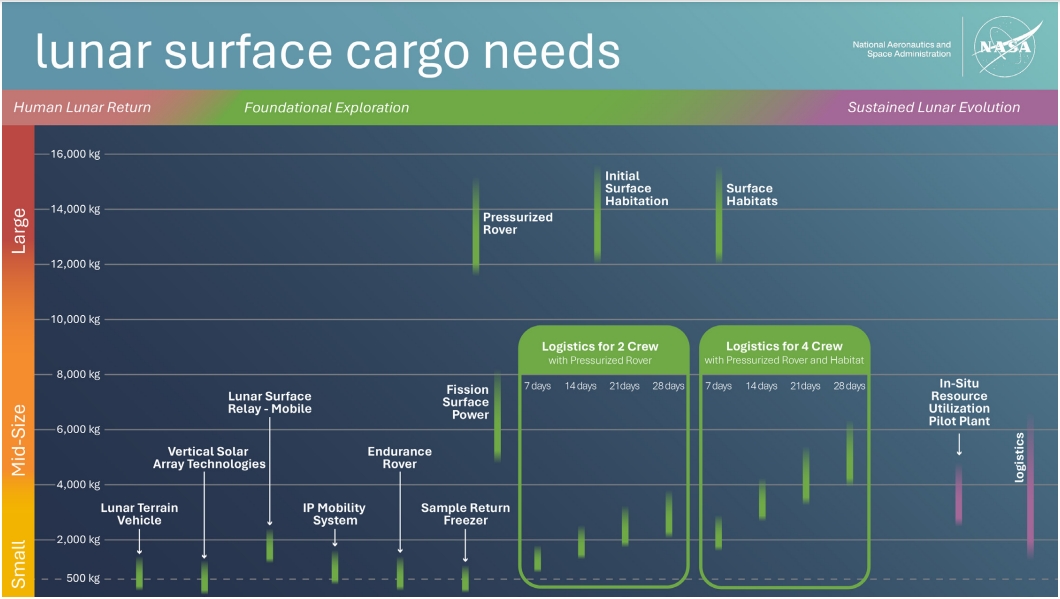
The Artemis program is underway and Artemis 3, its final mission destined to send astronauts back to the moonis scheduled for 2026. However, the purpose of this program is the creation of a lunar gateway, a sort of small orbital habitat to facilitate missions to and from the surface of the Moon. Let us especially mention the desire to build a moon base in order to allow humans to enter make long-term stays. NASA is well on its way to doing this, working with partners such as SpaceX and Blue Origin to transport crews and conduct scientific experiments on site. However, one important aspect of the project seems to be in question: the transport of goods in large quantities. In June 2024, NASA engineers published a white paper entitled Lunar Surface Cargo. In this document, the authors explain that they have identified a large gap between current capacities for delivering goods and future demand. For them, there would exist only one credible solution namely the establishment of a ” mixed fleet of landers” .
 Credits: NASA Lunar Surface Cargo
Between two and a half tons and ten tons of goods per year
Let us recall that a lander is a manned or unmanned spacecraft whose purpose is to land on a celestial body. The latter can be fixed (like Huygens on Titan) or integrate a rover like Opportunity on Mars. According to the authors of the report, NASA will not have to choose between these types of landers, but opt for a mix of the two. Currently, several companies in addition to SpaceX and Blue Origin are working on this problem, namely Sierra Nevada Corporation, Ceres Robotics and Tyvak Nano-Satellite Systems. It should be noted that this search for solutions for deliver the first shipments of material and crew concerns only the Human Lunar Return (HLR) phase of the Artemis program. Subsequently, the quantities of goods to be delivered will increase sharply to reach between two and a half and ten tons per year according to estimates, with sometimes special deliveries of around fifteen tonnes. This will therefore require a significant increase in freight capacities. Indeed, NASA is planning a expansion of its lunar systems over the period 2028-2030. Finally, it should be noted that the transport of goods will concern many aspectsincluding mobility systems, housing, communications and electricity, in addition to everyday needs (air, water, food, etc.). In addition, NASA will need to find solutions for manage waste repatriationand in particular human excrement.


