

What To Know
- Of all the temperate exoplanets currently known, LHS 1140 b may be our best chance to one day indirectly confirm the presence of liquid water on the surface of an alien world beyond our own.
- As the CNRS specifiesthis low density ” suggests the presence of a thick envelope of hydrogen and helium and/or a significant amount of water on the planet ” However, the use of these two super-powerful instruments of the JWST shows that LHS 1140b has lost its hydrogen and helium envelope.
- This proximity suggests that the planet’s water is — at least in part — in liquid form, whether on the surface or in its depths (see illustration above, in the center).
The first evidence of an “ocean exoplanet,” LHS 1140 b, has been obtained using the James Webb Space Telescope. But there are still many unknown factors to resolve to determine the nature of this super-Earth located 48 light-years away. The Space Telescope James Webb (JWST), since its launch in 2021, has already contributed enormously to science. And this summer of 2024 is no exception: JWST has transmitted data that change our point of view on a exoplanet that we already knew, located 48 light years away from us, in the constellation of the whale. It is called LHS 1140 b and was discovered in 2017. Astronomers then estimate that it could be a kind of mini-Neptune — in short, to be a gaseous planet, enveloped in a thin atmosphere of hydrogen and helium. But a team of planetologists from the CNRS and astrophysicists from the University of Montreal have recently analysis data delivered by JWST, and they point to an “ocean” exoplanet, mainly composed of liquid water. The study (online since June 21, 2024) will soon be published in The Astrophysical Journal. Of all the temperate exoplanets currently known, LHS 1140 b may be our best chance to one day indirectly confirm the presence of liquid water on the surface of an alien world beyond our own. solar system “, confirms in a press release Charles Cadieux, lead author of this study. The exoplanet would therefore be a super-Earth made up of an ocean.
How do you study a planet like LHS 1140 b?
Since the exoplanet is located 48 light-years from us, how can we assume, based on the beginnings of evidence, that it would be an ocean planet? The JWST carries, in particular, an instrument called NIRISS (Near-InfraRed Imager and Slitless Spectrograph). It is used to study the near-infrared radiation emitted by celestial objects. The behavior of the absorption of light, during specific phases of the planet’s transit relative to its star, provides information on the composition of an exoplanet. Another instrument was used, NIRSpec, at other wavelengths. Previous observations of LHS 1140 b have shown that this planet is of low density. As the CNRS specifiesthis low density ” suggests the presence of a thick envelope of hydrogen and helium and/or a significant amount of water on the planet ” However, the use of these two super-powerful instruments of the JWST shows that LHS 1140b has lost its hydrogen and helium envelope. So, with a higher level of plausibility, there remains the possibility of a planet rich in water.
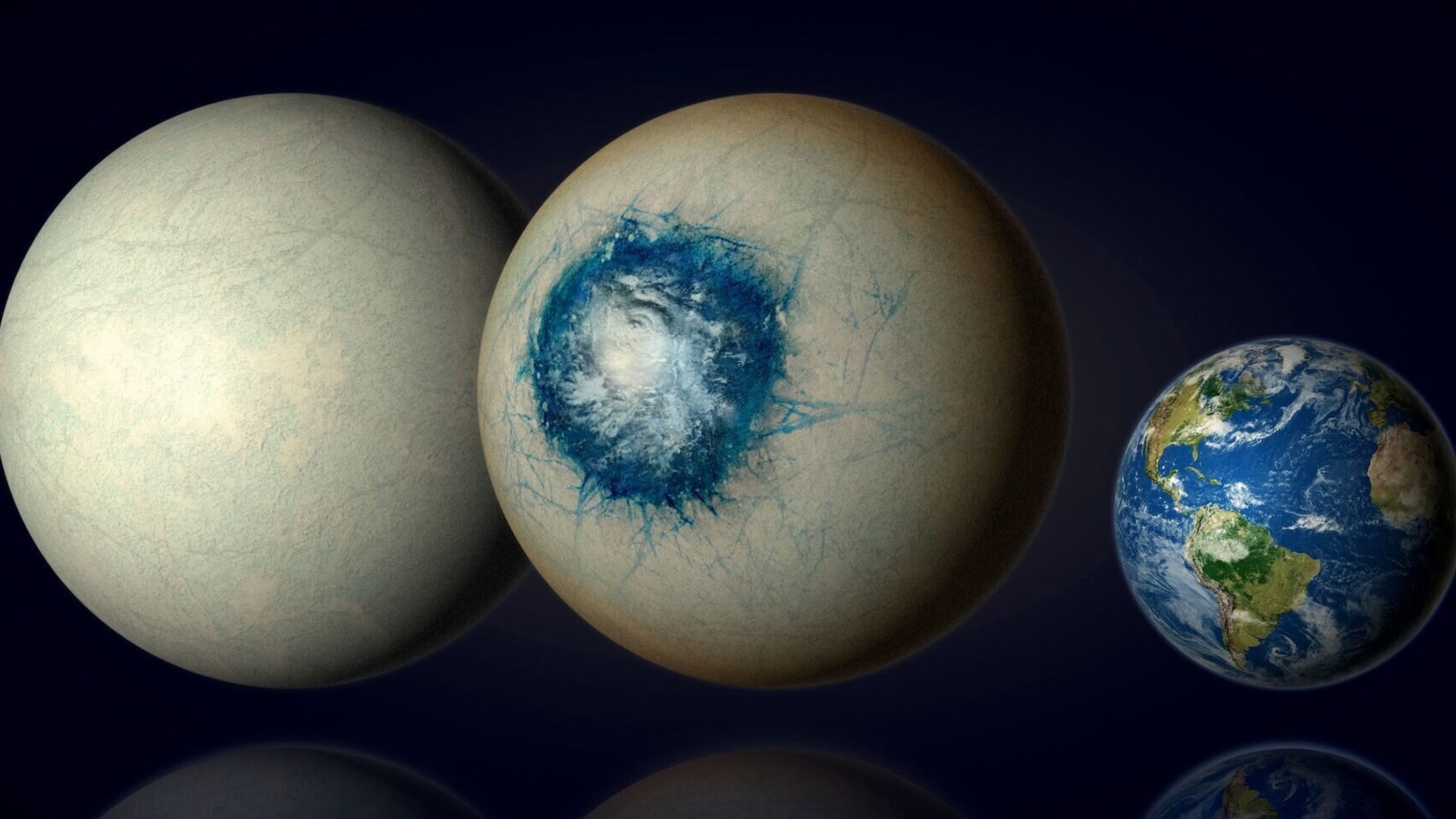 On the left, the ice ball hypothesis. On the right, the hypothesis of an “ocean” part. We can also see the difference in size with the Earth. // Source: Computer-generated image (B. Gougeon/Université de Montréal) Now that we assume that there is water, it can take several forms. Why do we hear about an ocean exoplanet? The distance between the planet and its star plays an important role here. LHS 1140 b is quite close to its suna red dwarf. This proximity suggests that the planet’s water is — at least in part — in liquid form, whether on the surface or in its depths (see illustration above, in the center).
A possible temperature of 30 degrees
” If LHS1140b had an Earth-like atmosphere, numerical climate simulations show that the surface temperature of this extraterrestrial ocean could reach temperatures of around 30 degrees Celsius. “, specifies the CNRS (which also arouses interest in its ” habitability “). So the question of the atmosphere also arises. Without an atmosphere, no ocean is possible. Many candidate exoplanets have ultimately been excluded from any presence of water and any possible biological “habitability” because, ultimately, they no longer had an atmosphere. Except that LHS 1140 b is a “super-Earth”, with a mass 5.6 times greater and a gravity twice as high as Earth. As a result, it is ” much more likely to have preserved its atmosphere ” Likewise, it seems that it contains nitrogen, like the Earth. ” We need at least another year of observations to confirm that LHS 1140 b has an atmosphere » All these clues constitute the most important bundle of tangible evidence ever obtained to date to suppose the discovery of an ocean exoplanet — at least in part. In part, because this planet always presents the same face to its star. The daytime part could therefore be liquid; and the dark part would then be icy. It is impossible, however, at this stage, to affirm that the discovery is confirmed or that these water/ice characteristics correspond entirely to reality. The investigation continues: it is now a question of characterizing the famous atmosphere of LHS 1140 b. And that takes time: ” We need at least another year of observations to confirm that LHS 1140 b has an atmosphere, and probably two or three more years to detect carbon dioxide. “, explains Professor René Doyon in the press release.
This content is blocked because you have not accepted cookies and other trackers. This content is provided by YouTube.
To be able to view it, you must accept the use made by YouTube with your data which may be used for the following purposes: allow you to view and share content with social media, promote the development and improvement of Humanoid products and its partners, show you personalized advertisements in relation to your profile and activity, define a personalized advertising profile for you, measure the performance of advertisements and content on this site and measure the audience of this site (learn more) By clicking on “I accept all”, you consent to the aforementioned purposes for all cookies and other trackers placed by Humanoid and his partners. You may withdraw your consent at any time. For more information, please read our Cookies policy. I accept everything Manage my choices


