

What To Know
- This process releases a colossal amount of energy in the form of radiation, making the black hole shine like a quasar, one of the most luminous objects in the Universe.
- Several studies have already revealed the presence of quasars very early in the Universe, suggesting much faster growth processes than we previously thought possibleThe question of how these cosmic ogres were able to accumulate such gigantic masses in such a short time remains one of the most captivating enigmas of modern astrophysics.
- The James Webb Space Telescope’s in-depth study of J1120+0641 expands our knowledge of early quasars and their role in galactic evolution, while also shedding light on exciting new questions about black hole physics and the cosmic processes that shaped the early Universe.
A team of astronomers announces that they have identified a quasar that appeared surprisingly normal when the universe was only 750 million years old.
The mysterious origins of supermassive black holes
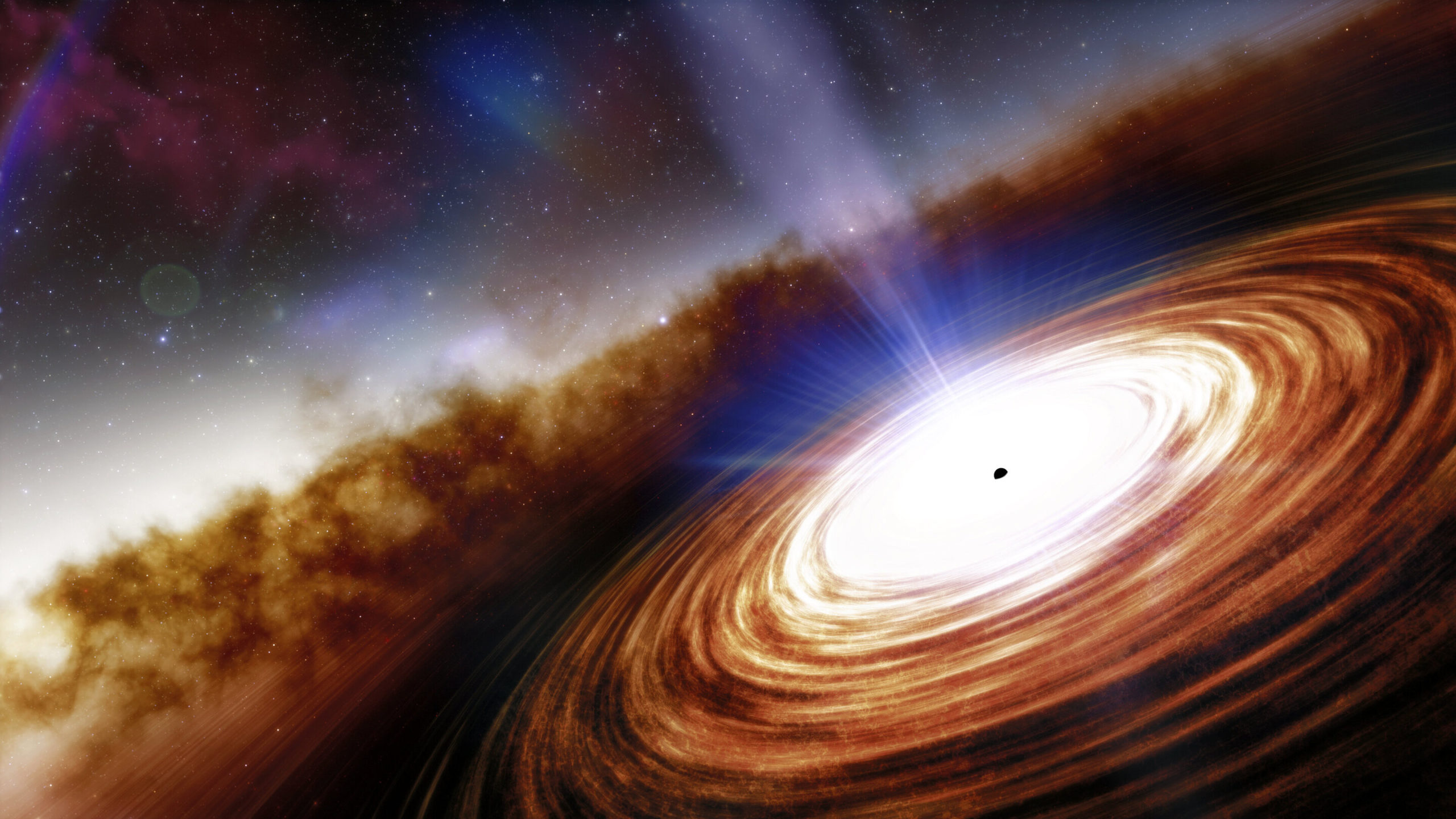
THE black holes are born from cataclysms of massive stars at the end of their lives, supernovas. When a star exhausts its nuclear fuel, it explodes violently, throwing its outer layers into space and leaving behind a dense core. If this core is massive enough, it collapses under its own weight and then forms a stellar black hole. These objects, although modest compared to their later descendants, are the first steps towards the cosmic monsters that are supermassive black holes. To go from stellar to supermassive black holes, several mechanisms are at play. One of the most crucial is accretion of matter. Located at the center of galaxies rich in gas and dust, black holes can indeed attract and engulf surrounding matter. This matter then forms an accretion disk around the black hole where it is heated to millions of degrees before disappearing into the event horizon. This process releases a colossal amount of energy in the form of radiation, making the black hole shine like a quasar, one of the most luminous objects in the Universe. Another path to supermassivity is the merger. When two galaxies collide, their central black holes can merge. This gigantic process also merges their black masses, forming an even more massive and powerful black hole. These galactic mergers are crucial to explain the presence of supermassive black holes in the centers of many galaxies today. However, recent observations challenge our current understanding. Several studies have already revealed the presence of quasars very early in the Universe, suggesting much faster growth processes than we previously thought possibleThe question of how these cosmic ogres were able to accumulate such gigantic masses in such a short time remains one of the most captivating enigmas of modern astrophysics.
 Credits: NOIRLab / NSF / AURA / J. da Silva
A quasar 750 million years after the Big Bang
Of new observations of the James Webb Space Telescope add even more mysteries. A particularly striking discovery is that of the quasar J1120+0641located just 750 million light years after the Big Bang. In recent work, researchers have been looking at this particular object. The observations made have revealed that J1120+0641 has similar properties to those of quasars observed in much more recent cosmological epochs. Key features include a bright accretion disk where matter is heated to extremely high temperatures before falling into the central black hole. This process then generates a massive amount of radiation, making J1120+0641 one of the brightest objects in the Universe at this early time. In addition, spectroscopic data collected by the telescope have allowed researchers to identify unusual signatures in the emissions from J1120+0641. These anomalies include material movement rates and variations in chemical compositions that do not match expectations based on existing models. For example, emissions of ionized carbon at rates higher than those observed in more recent quasars have been detected, posing additional challenges to our understanding of the evolution of supermassive black holes. Ultimately, the James Webb Space Telescope’s in-depth study of J1120+0641 expands our knowledge of early quasars and their role in galactic evolution, while also shedding light on exciting new questions about black hole physics and the cosmic processes that shaped the early Universe.


